If you just want the short answer: set up Alipay first. Then add WeChat as your second layer.
That is the cleanest recommendation for most first-time tourists going to China.
A lot of articles try to sound balanced and end up being useless. So here is the blunt version:
- Alipay is usually the better first wallet for tourists
- WeChat is still worth having, but more as backup + communication layer
- Neither is perfect, so carry some cash anyway
If you only have the patience to get one app working before your trip, make it Alipay. If you want a safer setup, do both.
Why this question matters so much
In a lot of countries, payment apps are optional convenience. In China, they are much closer to daily infrastructure.
You can survive without them, but you will feel the friction fast:
- stores expecting QR payments
- taxis and ride-hailing flows tied to app wallets
- restaurants and kiosks where foreign cards are awkward or useless
- small merchants who barely touch cash anymore
So the real question is not “which app is cooler?”
It is: which app gives a first-time tourist the best chance of paying successfully with the least setup pain?
That answer, for most people, is Alipay.
The practical difference in one sentence
Alipay is easier to recommend as your first tourist payment app.
WeChat is more useful once you also care about messaging, contacts, and local coordination.
That is the decision.

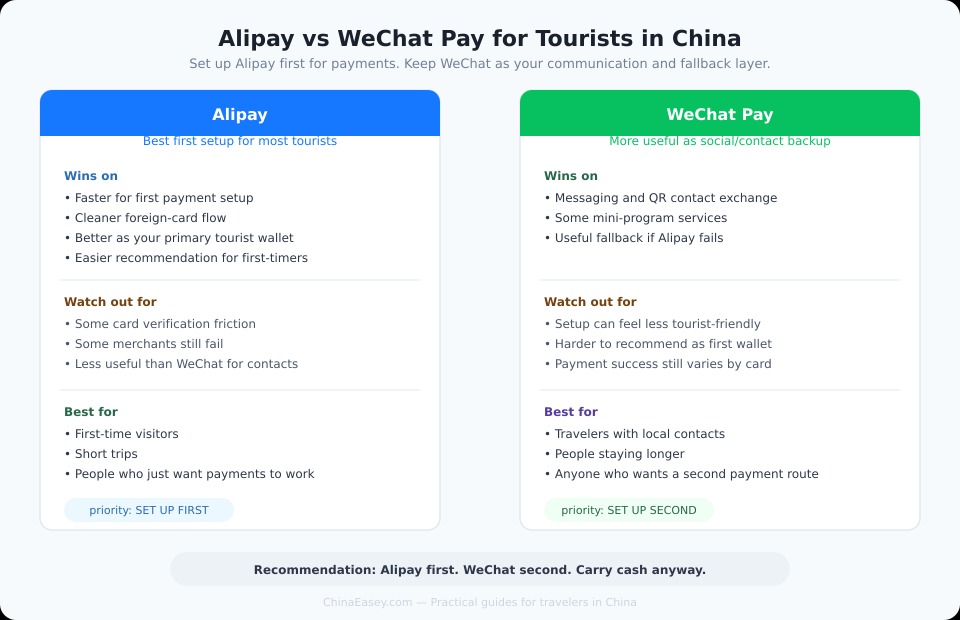
Alipay vs WeChat Pay for tourists in China — setup, acceptance, communication, and fallback value
Alipay vs WeChat Pay: side-by-side on what actually matters
1. Account setup
For a tourist, Alipay usually feels more straightforward.
Both apps have improved a lot for foreign users, but Alipay is still easier to explain in one line:
download app → register → link card → verify if prompted → try paying
With WeChat, payment setup often feels more tied to the broader WeChat ecosystem. That is fine if you already use WeChat or have local contacts. It is less clean if all you want is to land in China and buy lunch without drama.
Winner: Alipay
2. Linking a foreign bank card
Both now support international cards better than they used to. But support is not the same thing as smoothness.
In practice, Alipay is still the more obvious starting point for foreign-card setup. It is where more travel advice naturally points people first, and for good reason.
With WeChat Pay, some tourists get it working quickly. Others hit weird friction and cannot tell whether the problem is the card, the account, the region, or the app flow.
That uncertainty matters when you are setting this up under time pressure.
Winner: Alipay
3. Payment success rate in daily life
This is where people want a clean winner. Reality is messier.
Both Alipay and WeChat Pay are widely accepted in China. In many stores, restaurants, malls, taxis, and convenience chains, either one works.
The issue is not broad acceptance. The issue is edge-case failure.
Sometimes the merchant accepts one wallet more smoothly than the other. Sometimes your foreign card behaves differently inside the two ecosystems. Sometimes the merchant setup is just weird.
So for raw day-to-day payment coverage, they are both strong. But if you force me to recommend one as a tourist's first line, I still lean Alipay because it tends to create less confusion during setup.
Winner: slight edge to Alipay for first-timer reliability
4. Merchant acceptance
For most tourists, merchant acceptance is effectively a tie.
In normal urban travel situations, both are accepted almost everywhere that expects QR payment. The average traveler is not going to notice a huge difference in coffee shops, restaurants, convenience stores, or mall counters.
Where acceptance gets messy is not “Alipay vs WeChat” — it is:
- foreign card compatibility
- merchant-specific setup
- app verification state
- whether your phone and internet are stable
So if you are choosing between them only on acceptance, you are focusing on the wrong thing.
Winner: tie
5. Ride-hailing, mini programs, and service ecosystem
This is where WeChat gets more interesting.
WeChat is not just a wallet. It is a communication app, QR identity layer, and mini-program ecosystem. If you are staying longer, coordinating with people locally, joining group chats, contacting service providers, or using more China-native flows, WeChat becomes much more valuable.
Alipay can still handle a lot of practical payment use, but WeChat reaches further into daily local coordination.
So if your trip is not just “pay for stuff,” and starts becoming “communicate, coordinate, scan, confirm, contact,” WeChat gets stronger.
Winner: WeChat
6. Communication and staying reachable
This one is easy.
Alipay is not your communication tool.
WeChat is how a lot of people in China actually stay in touch:
- hotels and local contacts may prefer it
- service providers may send info there
- people share QR codes instead of phone numbers
- group planning often happens there
If you are only thinking about payment, you miss the point. WeChat often matters because it helps you move through China socially and practically, not just financially.
Winner: WeChat
7. Fallback value when something fails
This is the most important reason to have both.
If your Alipay payment fails, WeChat may still work.
If your WeChat Pay setup gets annoying, Alipay may still carry your trip.
If both fail, cash can still save you in basic situations.
Tourists get into trouble when they build a payment setup around one app, one card, and one assumption.
That is brittle.
The stronger setup is:
- Alipay first
- WeChat second
- one physical card
- some emergency cash
Winner: both matter — but Alipay still comes first
So which one should tourists set up first?
For most first-time foreign visitors:
Set up Alipay first if you:
- want the simplest path to mobile payment
- only care about getting through everyday purchases smoothly
- are on a short trip
- do not already use WeChat much
- want one app to solve the payment problem first
Add WeChat second if you:
- have local contacts, hosts, guides, or service providers
- expect to use QR contact exchange often
- may need mini programs or local communication
- want a second payment path in case Alipay fails
- are staying longer than a quick city break
That is the recommendation. Not because WeChat is weak. It is not. But because Alipay is the cleaner first setup for tourists.
Who should not overthink this
If you are a normal short-stay tourist going to Shanghai, Beijing, Guangzhou, or Shenzhen for 5 to 10 days, do not get lost in forum debates.
Your stack should be:
- Alipay
- one backup card
- some RMB cash
Done.
That is enough.
Common failure scenarios tourists run into
“My card linked, but payment still failed.”
Very common. Linking a card is not the same as proving that every merchant flow will work.
“The merchant said they accept QR payment, but it still did not go through.”
Also common. Acceptance in theory and success in practice are not always the same thing.
“WeChat worked for messaging, but I could not get the payment part stable.”
This is exactly why I do not recommend it as your only setup.
“I thought my foreign Visa card would be enough.”
Usually not. At least not if you want a smooth day.
“I landed first and planned to set everything up at the airport.”
Terrible idea. That is when fatigue, bank alerts, bad Wi-Fi, and confusion all show up at once.
What we recommend before you fly
- Install Alipay.
- Link your foreign card.
- Complete any verification prompts.
- Install WeChat.
- Get the account stable, even if you do not use payment immediately.
- Carry some cash anyway.
- Do all of this before departure, not after landing.
That setup gives you much more resilience than trying to pick one “perfect” app.
FAQ
Is Alipay or WeChat Pay better for tourists in China?
For most tourists, Alipay is better as the first app to set up. It is easier to recommend as a primary payment wallet. WeChat is still worth having, but more as backup plus communication tool.
Do I need both Alipay and WeChat Pay?
Strictly speaking, no. Practically, yes — if you want fewer failure points. One can back up the other.
Can foreigners use WeChat Pay in China now?
Yes, many foreigners can. But “supported” does not always mean “smooth in every situation.” Setup and card performance can still vary.
Which app is accepted more in China?
For most tourists, acceptance is effectively similar. The bigger issue is not acceptance; it is whether your account, card, and payment flow work properly when you need them.
Should I bring cash if I have both apps?
Yes. Always. Not a huge amount, but enough to get out of trouble if both apps fail.
Final call
If you want the simplest practical answer, here it is again:
Set up Alipay first. Add WeChat second. Carry some cash anyway.
That is the most sensible payment stack for a first-time tourist in China.
Trying to pick one forever is the wrong mindset. You are not choosing a religion. You are building a travel setup with fewer failure points.
Want Help Getting Your China Setup Right Before You Fly?
Payments are only one part of the arrival puzzle. Internet, maps, apps, transport, and first-24-hours friction matter just as much.
Need more than the guide?
This guide covers the basics. If real-world friction shows up, you can compare the support options and choose the level of human backup that fits your trip.