Can Foreigners Go to Hospitals in China? What to Expect and How to Prepare
Short answer: yes, foreigners can walk into Chinese hospitals and receive care. There's no law barring you, no gate that checks your passport before treatment, and no requirement to have Chinese residency. But "you can go" and "you'll have a smooth experience" are two very different things — and the gap between them depends almost entirely on which type of facility you choose and how prepared you are when you show up.
This guide is not about whether Chinese medicine is good or bad. It's about helping you figure out which path makes sense for your specific situation, what to expect when you get there, and what to prepare before anything goes wrong.
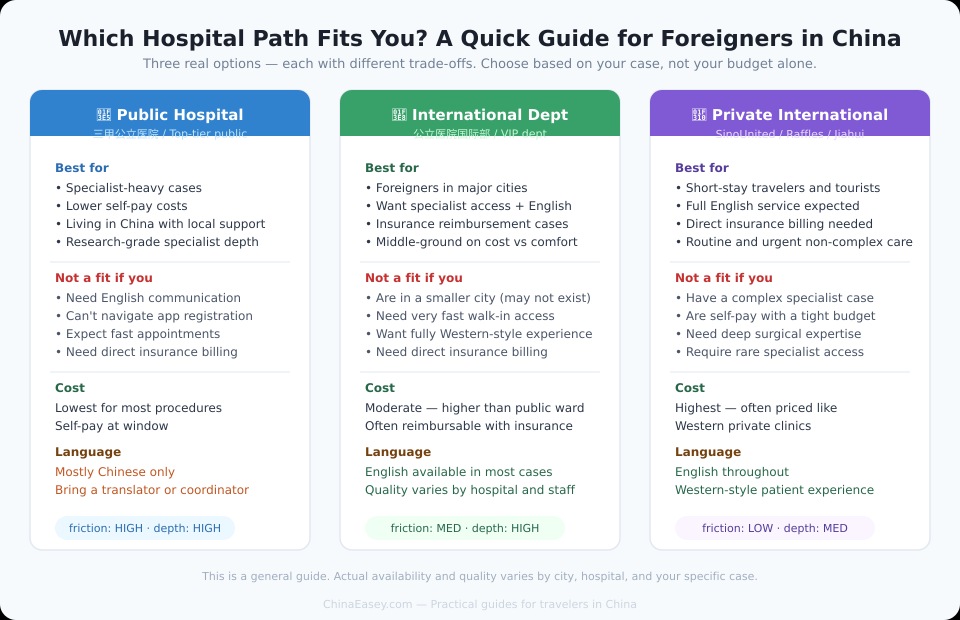
The Three Paths: Public Hospital, International Department, or Private International Hospital
There isn't one version of "going to a hospital in China." There are three meaningfully different options, each with a different cost structure, language environment, and experience level. Here's what they actually look like on the ground.
Path 1 — Public Hospital (Standard Track)
Public hospitals in China are the backbone of the healthcare system. Most cities have them ranked by tier: Level 3 (三甲, sān jiǎ) is the highest and where most serious cases go. They're affordable, often excellent on the clinical side, and almost entirely in Chinese.
What it's actually like: You'll register at a kiosk or window, often pay a small registration fee (挂号费, around ¥5–50 depending on the specialist), and wait — sometimes a long time. Appointments exist in theory but in practice the queue moves unpredictably. Consultations can be short. Doctors are busy. If you don't speak Mandarin and don't have someone with you who does, you will struggle.
Cost: Very low by international standards. A standard consultation might cost ¥100–300. Even hospital stays are significantly cheaper than what you'd pay in Western countries. But you pay upfront in cash or via WeChat Pay / Alipay, and getting reimbursed by foreign insurance is often a paperwork nightmare.
Language: Almost no English in most cities outside Shanghai, Beijing, and Guangzhou. Some younger staff may have limited English but won't be consistent.
Good fit for:
- Long-term residents who speak Mandarin or have a Chinese-speaking partner/colleague
- Non-urgent situations where cost matters more than convenience
- Follow-up visits when you already understand the system and have a local contact
Bad fit for:
- Anyone who doesn't speak Mandarin and is going alone
- Emergency situations where communication speed is critical
- Complex diagnoses that require back-and-forth discussion of symptoms
- Tourists or short-term visitors with no local support
Path 2 — Public Hospital International Department (国际部)
Many large Level 3 hospitals — particularly in Beijing, Shanghai, Guangzhou, and Shenzhen — have a separate international department (国际部, guójì bù). Think of it as a public hospital with a buffer layer: same doctors, same labs, but with English-speaking coordinators, a calmer registration process, and billing set up for insurance companies.
What it's actually like: The waiting environment is noticeably different — less crowded, more like a mid-range clinic. Staff in the international section are used to foreign patients and most communication can happen in English. Doctors often rotate between the main hospital and the international department, so clinical quality tends to be solid.
Cost: Significantly higher than the standard track. A consultation might run ¥500–1,500. Procedures and diagnostics are priced at a premium. The trade-off is that the billing documentation is usually formatted to work with international insurance providers.
Language: Generally manageable in English. Not perfect — there may still be moments where you need to point at a translation app — but you won't be completely lost.
Good fit for:
- Expats with international health insurance
- Anyone who needs specialist care and wants a better navigation experience than the standard track
- Situations that aren't emergencies but are serious enough that you want real clinical backup
Bad fit for:
- Budget travelers — the premium isn't worth it if you're paying out of pocket for something minor
- Very urgent emergencies (the standard ER is usually faster)
- Smaller cities that don't have an international department at all
Path 3 — Private International Hospital
Places like United Family Hospital (和睦家), Parkway Health, and Raffles Medical are built for foreigners and high-income Chinese patients. Everything is in English. The facilities look more like what you'd expect in Singapore or Germany. The staff have dealt with foreign insurance billing hundreds of times.
What it's actually like: You schedule an appointment online or by phone in English. You show up, check in, see a doctor who speaks fluent English, and get a clear diagnosis in language you understand. If you need a referral or follow-up, they manage it. It's the closest experience to what you're used to at home.
Cost: High. A standard GP visit can run ¥800–2,000. Specialist consultations, procedures, and hospital stays can be substantially more. Without insurance, it adds up fast. With good international insurance that has direct billing agreements, it can be nearly seamless.
Language: Full English (and often other languages depending on the facility).
Good fit for:
- Expats on corporate packages with solid international insurance
- Families with children who need reliable, English-language pediatric care
- Anyone who needs a mental health consultation, therapy, or nuanced communication-heavy care
- Short-term visitors who have a genuine medical need and don't want to navigate the system alone
Bad fit for:
- Anyone paying fully out of pocket for something non-serious — the markup is real
- Trauma or cardiac emergencies — you'll likely still end up in a public hospital ER for acute stabilization

How to choose a hospital path in China as a foreigner — public hospital, international department, or private international hospital
Booking an Appointment: How It Actually Works
Registration (挂号, guà hào) is the first step at any public hospital. You pick a department, pay the registration fee, and get a number. In many large hospitals, this now happens via an app (like the hospital's own WeChat mini program or a third-party platform like Beijing Health Kit) before you even arrive.
If you're going through an international department, call ahead or book via their website. Most have an English line or an online form.
For private international hospitals, their websites are usually in English with clear booking flows. Some offer same-day appointments for non-urgent issues.
Practical tip: Don't show up at a top-tier public hospital on a Monday morning without a plan. It's the busiest time of the week. Book online the night before if you can, or go to a smaller district-level hospital for non-urgent issues — the wait is much shorter.
Insurance and Out-of-Pocket Reality
If you have international health insurance from a reputable provider (Cigna, AXA, Allianz, Bupa, etc.), check two things before you go:
- Does your policy cover China? Most do, but some have exclusions or require pre-authorization for non-emergency care.
- Does the hospital have a direct billing agreement? If yes, you pay little or nothing upfront. If no, you pay out of pocket and submit a reimbursement claim — which works, but takes time and paperwork.
Private international hospitals and large hospital international departments are far more likely to have insurance relationships than standard public hospital tracks.
If you're uninsured or traveling without coverage: Public hospital care is genuinely affordable. A GP visit and basic blood work might run ¥200–400 total. Even more complex care is a fraction of what it costs in the US or Australia. The main friction is navigation and language, not price.
Chinese social insurance (社保) is generally not available to foreigners unless you're on a local employment contract and your employer has enrolled you. Even then, some cities have restrictions on which facilities will accept foreign residents on social insurance.
What to Bring
Before you go to any hospital in China, have these ready:
- Passport — this is your primary ID for registration. Residency permit (居留证) works too if you have one.
- Insurance card or policy number — if you have coverage, bring the card and know the emergency hotline
- Medical history in English and Chinese if possible — allergies, chronic conditions, current medications (generic names, not brand names, translate better)
- WeChat Pay or Alipay — most hospitals accept these for payment; cash also works but large bills can be awkward
- A translation app — Pleco (for terms) or Google Translate's camera function can help in a pinch
- A Chinese-speaking contact you can call — even a colleague or neighbor you can reach by phone can make a significant difference
For non-emergency situations: research the specific hospital and department in advance. Knowing you want 消化内科 (gastroenterology) before you arrive is better than trying to figure it out at the registration desk.
What ChinaEasey Can and Can't Do
We're not a hospital and we don't practice medicine. We can't diagnose, prescribe, or guarantee any clinical outcome. Full stop.
What we can help with:
- Matching you to the right facility — based on your city, situation, insurance, and language needs
- Pre-visit preparation — what to expect, what documents to bring, how registration works at a specific hospital
- Interpreting medical terminology — so you understand what a doctor told you or what a report says (not diagnoses — translation)
- Insurance navigation — understanding what your policy covers, which hospitals have direct billing, how to file a claim
- Follow-up logistics — prescription pickup, follow-up booking, getting results translated
We work best as a planning layer — before or after the clinical appointment, not during. Think of us as the person who knows the system and can help you move through it without wasting time or making avoidable mistakes.
If you're in a life-threatening emergency, call 120 (China's emergency number) immediately. Don't wait for help from any third party.
FAQ
Q: Will I be treated differently as a foreigner in a Chinese public hospital?
In most cases, no — you're a patient like anyone else. Staff may be surprised and occasionally unsure how to handle registration for foreign passports (some older systems only accept Chinese ID numbers), but this is a procedural hiccup, not discrimination. In cities with large expat populations, public hospital staff have seen this before. In smaller cities, be patient and bring a Chinese speaker if you can.
Q: Do I need to speak Mandarin to get care at a public hospital?
Technically no, but practically it helps enormously. The registration process, consultation, and discharge instructions are all in Chinese. Doctors at standard public hospitals rarely speak English fluently enough for a medical conversation. If you don't have any Mandarin and can't bring someone who does, go to an international department or private hospital instead — the cost difference is worth the clarity.
Q: Can I use my foreign health insurance in China?
Yes, most international policies work in China. The key variables are: whether China is in your coverage territory, whether the hospital has a direct billing relationship with your insurer, and whether you need pre-authorization for non-emergency visits. Call your insurer's emergency line before you go for anything planned. For emergencies, go first and sort the paperwork after.
Q: How do I get a prescription filled? Can I get my regular medication in China?
Prescriptions from Chinese hospitals can be filled at hospital pharmacies or licensed drug stores (药店, yào diàn). Common medications — blood pressure drugs, diabetes medications, antibiotics, antihistamines — are usually available at very low cost. Brand names will be different; generic chemical names travel better. Some medications common in Western countries are controlled or simply not available in China (certain ADHD medications, some psychiatric drugs, specific biologics). If you're on a specialized regimen, bring a 90-day supply and a letter from your home doctor explaining the medication.
Q: What happens if I need surgery or hospitalization?
You'll be admitted through the standard process — deposit required upfront (usually several thousand RMB), with settlement at discharge. International departments and private hospitals handle this more smoothly for foreign patients, including insurance pre-authorization. For anything major, we strongly recommend having a local contact or medical coordinator who can communicate with the care team on your behalf. This is exactly the kind of situation where planning ahead matters.
The Bottom Line
China's hospital system works. Foreigners use it every day — for routine checkups, specialist visits, emergency care, even surgery. The system is not designed with foreign patients as the primary audience, but it's also not closed to them.
Your experience depends almost entirely on which path you choose and how prepared you arrive. Go to the right type of facility for your situation. Bring the right documents. Know your insurance situation before you need it. Have a plan for language.
If you're not sure where to start — especially if you're dealing with something more than a minor issue — don't try to figure it out alone in a hospital lobby.
Need Help Planning Your Care in China?
Whether you're still outside China trying to prepare, or already here and unsure where to go — we can help you figure out the right path, what to expect, and what to prepare.
We'll match you to the right facility type, walk you through logistics, and make sure you're not navigating this alone.
Need patient-side support?
If you are evaluating treatment in China, we can help with case triage, hospital matching, logistics planning, and realistic next steps.