
Yes. Foreigners can use Alipay in China in 2026.
But the real answer is more specific: you can usually use Alipay with a foreign passport and an international bank card for many everyday payments in China, but setup friction, card compatibility, merchant acceptance edge cases, and identity checks still matter.
If you are visiting China for the first time, the mistake is assuming "I installed Alipay" means "my payments are fully sorted." It does not. You still need to set it up correctly, test it before you need it, and know your fallback options.
This guide is for first-time foreign travelers who want a practical answer, not marketing fluff.
The short version: what foreigners should expect
If you are traveling to China and want to pay like everyone else, Alipay is usually one of the best tools to set up before you arrive.
For most foreign visitors, Alipay is useful for:
- store payments by scanning or showing a QR code
- taxis and ride-hailing
- convenience stores, malls, and restaurants
- some transport and travel bookings
- some mini-program services inside the app
What catches people off guard is that "available" does not mean "friction-free."
You may still run into:
- a card that fails verification
- a payment that works at larger merchants but not in a smaller edge case
- a name or passport mismatch during identity checks
- limited usability if you set it up too late or rush through verification
- confusion between balance, bank card, Tour Pass style features, and merchant-specific payment flows
So yes, foreigners can use Alipay in China. The more useful question is: how do you make sure it actually works when you need to pay?
Who this is for
This article is mainly for:
- first-time tourists going to China
- short-stay business travelers
- visitors who do not have a Chinese bank account
- people who want a backup before landing
This article is less useful if:
- you already live in China and use local banking regularly
- you need a China payments solution for business settlement rather than travel spending
- you are trying to solve every digital access problem with one app alone
How Alipay setup works for foreign travelers

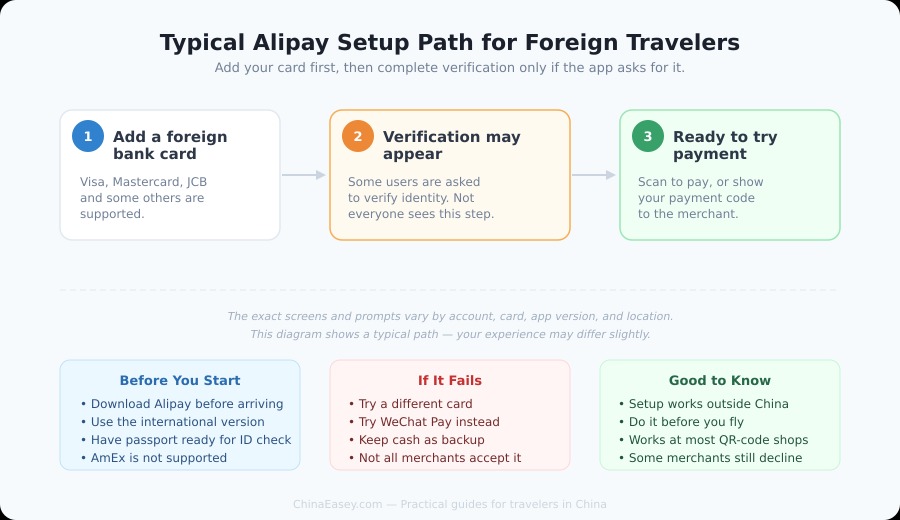
How Alipay setup works for foreign travelers — add card, verify if needed, then pay by QR code
The typical path is: add your foreign card → complete identity verification if prompted → scan or show QR code to pay. Not every step hits every user the same way — verification is not always required, and some cards work more smoothly than others.
What Alipay can and cannot solve for travelers
What Alipay helps with
Alipay helps reduce one of the biggest first-24-hours problems in China: not being able to pay quickly and confidently.
If it is working properly, it can make daily transactions much easier than relying on cash or hoping every international card terminal will work.
For many travelers, Alipay becomes useful for:
- paying in shops that expect QR-based payments
- covering small everyday spending without awkward card terminal issues
- reducing language friction at checkout
- handling some local app and service flows more smoothly
What Alipay does not solve
Alipay does not guarantee that every payment scenario will work perfectly.
It also does not replace basic travel preparation such as:
- having a second payment method
- carrying some emergency cash
- confirming your bank allows the transaction
- checking whether your phone number, passport name, and card details match properly
- preparing for connectivity issues if your internet access is unstable
If your whole China plan depends on one app working perfectly under pressure, that is weak planning.
Can foreigners sign up for Alipay without a Chinese bank account?
In many cases, yes.
That is the main reason this topic matters so much. Historically, foreign users often assumed Chinese digital wallets were effectively off-limits without a local bank account. That is no longer the practical reality for many short-term travelers.
Today, many foreign visitors can register, complete identity steps, and link an eligible international card for spending in China.
That said, "can" is not the same as "every card from every country works in every payment flow." Your actual experience depends on:
- your passport and identity verification flow
- your card network and issuing bank
- whether the merchant supports the relevant payment path
- your phone number and app setup state
- whether Alipay asks for additional checks
So the correct planning assumption is:
You probably can use Alipay as a foreigner in China, but you should verify your own setup before you rely on it.
What you need before you set it up
Before you start, prepare these basics:
- your passport
- a working mobile number that can receive codes
- an eligible international bank card
- stable internet connection during setup
- your legal name entered consistently across documents where possible
It also helps to have:
- a second card in case the first one fails
- WeChat Pay or another backup payment route if possible
- some RMB cash for low-probability failure moments
This part sounds boring, but it is exactly where most avoidable pain starts.
How to set up Alipay as a foreigner before going to China
The exact screens may change, but the overall process is usually straightforward.
Step 1: Install the app early
Do not wait until you land.
Set up Alipay before departure, while you still have:
- familiar network access
- time to retry if something fails
- access to your bank if card verification triggers an alert
- less pressure overall
If possible, complete setup several days before travel, not during airport chaos.
Step 2: Register with your mobile number
Use a number you can access reliably.
If the app sends a code and you cannot receive it later, fixing the account under travel pressure is a terrible use of time.
Step 3: Complete identity verification
This is where your passport details matter.
Enter your information carefully. If your name formatting differs from your card or official document format, you increase the chance of problems later.
Step 4: Link your international bank card
Add your card inside the app and follow the prompts.
This is the part most travelers care about, because it determines whether the app is just installed or actually usable.
If your bank blocks the attempt, you may need to:
- approve the transaction or verification in your banking app
- contact the bank
- try another card
- retry later after a fraud check clears
Step 5: Check whether the payment path is active
Do not stop after the card appears in the app.
Look for a usable pay/scan flow and make sure the app appears ready for real transactions.
Step 6: Test a low-risk transaction if possible
If you can safely test before or right after arrival, do it with a simple small purchase rather than waiting until you are under real pressure.
Where Alipay usually works well for foreigners
In practical terms, Alipay is most useful in the places where China's QR payment culture is already normal:
- convenience stores
- chain restaurants
- malls and larger shops
- transport-related spending
- ride-hailing and some travel flows
In these situations, Alipay can feel much easier than trying to explain foreign card usage at a terminal that may or may not cooperate.
Where travelers still get stuck
This is the part many glossy guides underplay.
1. Setup succeeded, but payment still fails
This is one of the most frustrating outcomes. The app looks ready, but the live payment does not go through.
Possible reasons include:
- your bank declined the transaction
- the merchant flow behaved differently than expected
- the card was linked but not functioning smoothly for that scenario
- a verification or risk control step was triggered
2. Merchant acceptance is not perfectly universal
A lot of content makes it sound as if one wallet solves everything everywhere. That is too neat.
China is highly digital, but real-world payment acceptance still depends on merchant setup, context, and the payment path being used.
3. You waited too long to set it up
People assume they can handle it after landing, then discover they are juggling airport arrival stress, local internet issues, bank verification delays, fatigue, and language friction all at once. That is a bad time to troubleshoot finance.
4. You have no fallback
Even if Alipay works for most of your trip, you should not design your payment plan around a single point of failure.
Should you also set up WeChat Pay?
Usually yes, if you can do it without creating extra confusion.
Alipay is strong, but first-time travelers are better protected when they have more than one realistic payment route.
A reasonable first-timer setup is:
- Alipay as primary wallet
- WeChat Pay or another backup if available
- one physical bank card
- emergency cash
Common mistakes foreigners make with Alipay in China
Treating installation as readiness. Downloading the app is not the same as being payment-ready.
Assuming every merchant flow is identical. Some guides flatten the experience too much. Real payment situations vary.
Skipping a fallback plan. If your first transaction fails and you have no backup, you create stress that was easy to avoid.
Leaving setup to the last minute. This is the classic own goal.
Not checking whether your bank will cooperate. Some banks are fine. Some become annoying the moment cross-border verification appears.
What to do if your Alipay does not work in China
If Alipay fails when you need it, do this in order:
- Check your internet connection first.
- Check whether the linked card is still active and recognized.
- Look for a bank fraud alert or app approval request.
- Retry with a different merchant or payment scenario later.
- Use your backup method instead of spiraling at the counter.
- Troubleshoot when you are not blocking a queue.
The main rule: solve payment problems before they become public stress events.
FAQ
Can tourists use Alipay in China?
Yes. In many cases, tourists can register and use Alipay in China with a foreign passport and supported international bank card.
Do you need a Chinese bank account to use Alipay in China as a foreigner?
Often no. Many foreign visitors can use Alipay without a Chinese bank account, but actual usability still depends on card compatibility, verification, and merchant context.
Can you set up Alipay after arriving in China?
Yes, but it is a worse idea. Setup is much easier before departure, when you still have time, stable connectivity, and access to your bank.
Does Alipay work everywhere in China for foreigners?
No payment method works perfectly everywhere in every scenario. Alipay is widely useful, but travelers should still expect some edge cases and keep a backup.
What if my foreign card fails on Alipay?
Check your bank first, look for verification prompts, and use a backup payment method if needed. Do not rely on one card or one app for the whole trip.
Is Alipay better than cash for travelers?
For many everyday situations in China, yes. But cash is still worth carrying as a fallback.
Final verdict
So, can foreigners use Alipay in China?
Yes — and for many travelers, they absolutely should set it up before the trip.
But the useful version of that answer is this: Alipay is a strong part of a China travel setup, not a magic fix for every payment problem.
If you prepare it early, verify your card, and keep a backup, it can remove a lot of arrival friction. If you assume it will just work automatically in every situation, you are setting yourself up for avoidable stress.
Ready to Sort Your China Setup Before You Fly?
Payments are just one piece. Internet, navigation, apps, transport — there's a lot to get right before you land.
Need more than the guide?
This guide covers the basics. If real-world friction shows up, you can compare the support options and choose the level of human backup that fits your trip.