
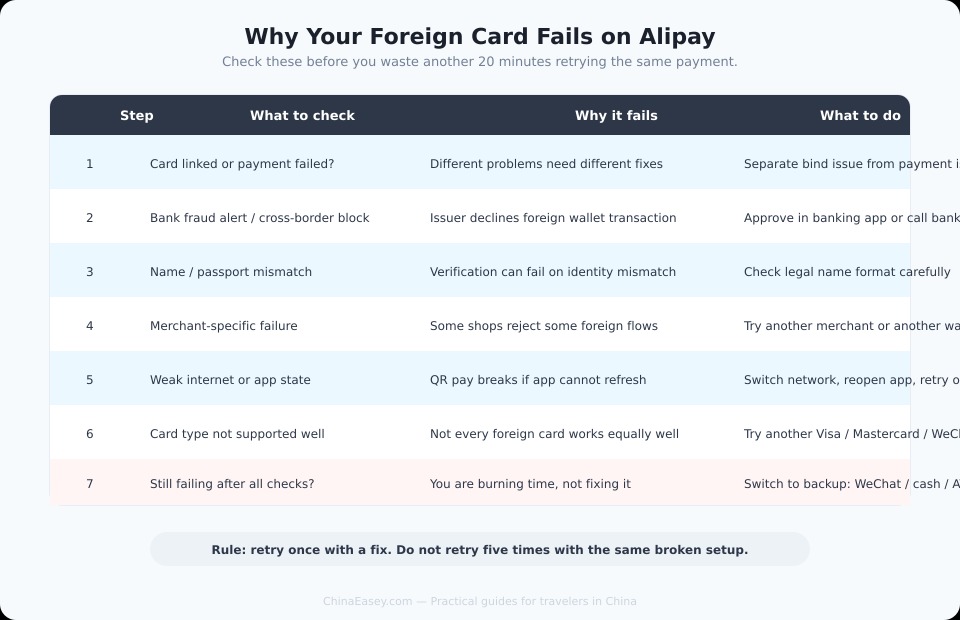
Short answer: the problem is usually one of six things:
- your bank blocked the transaction
- Alipay wants identity verification
- your legal name does not match cleanly
- the card linked, but that merchant still failed
- your app/network state is broken
- the card itself is a weak fit for Alipay
That is the practical version.
Most travelers waste time because they treat every Alipay failure like the same problem. It is not.
The first thing you need to figure out is this:
Is the problem card linking, or payment after linking?
These are different failures.
Problem A: the card will not link at all
This usually points to:
- bank-side fraud or cross-border block
- card type / issuer mismatch
- identity verification issues
- name formatting mismatch
- app/account setup problems
Problem B: the card linked, but payment still fails
This usually points to:
- merchant-specific rejection
- risk control on that transaction
- temporary network/app issue
- card works in theory, but not reliably in that flow
If you do not separate those two, you end up trying the wrong fix over and over.
The most common reasons your foreign card fails on Alipay
1. Your bank blocked it
This is probably the most common reason.
From your side, it looks like Alipay is broken. From your bank's side, it looks like a weird overseas wallet transaction they do not fully trust.
This is especially common if:
- you have never used the card in China before
- you are trying to link it right before travel
- your bank is conservative on fraud checks
- you are using a card issuer that gets jumpy with foreign e-wallets
What to do:
- open your banking app and look for an approval request
- check text messages or email for fraud alerts
- call the bank and ask whether they blocked a China / Alipay transaction
- tell them you are traveling and need cross-border wallet payments enabled
2. Your identity details do not match cleanly
This catches more people than it should.
If your passport says one version of your name, your card shows another format, and your Alipay profile has a third variation, you are creating avoidable friction.
Examples:
- middle names handled differently
- surname/given name order confusion
- passport romanization mismatch
- shortened or missing names on the card
What to do:
- use your full legal passport-style name where possible
- check spacing and order carefully
- if the card uses initials or shortened formatting, understand that this may create verification friction
3. Alipay wants more verification than you expected
A lot of travelers think downloading the app and linking the card means they are done.
Not always.
Sometimes Alipay asks for:
- identity verification
- passport upload or manual review steps
- extra confirmation after linking
If you skip these or rush them, the app may look “set up” while still being weak in practice.
What to do:
- check whether your account is fully verified
- look for alerts inside the app, not just on the card screen
- complete the process before you need the app at a checkout counter
4. The merchant failed, not the whole wallet
This is where people overreact.
One failed payment does not automatically mean your foreign card cannot work on Alipay at all.
Sometimes the problem is just that specific merchant, terminal, or payment route.
That is why “linked successfully” and “worked at this exact shop” are different tests.
What to do:
- try another merchant before declaring total failure
- test at a convenience store or chain shop with normal QR flow
- do not judge the whole setup from one chaotic moment
5. Your app or network state is bad
If your phone connection is unstable, the app is outdated, or the QR/payment page failed to refresh properly, you can get a payment failure that looks more dramatic than it is.
This happens a lot when travelers are:
- on weak airport Wi-Fi
- using shaky roaming
- switching VPNs in the background
- working with a frozen or half-loaded app session
What to do:
- switch networks if possible
- fully close and reopen Alipay
- log out and back in only if necessary
- update the app if it is stale
- retry once, not five times
6. Your card is just a bad fit for Alipay
Not every foreign card performs equally well.
Some cards are fine. Some are technically supported but annoying. Some are a waste of time.
If you keep hitting failure after a clean setup, the issue may be the card issuer rather than something you can “fix.”
What to do:
- try another Visa or Mastercard if you have one
- prefer a mainstream bank issuer over niche cards when possible
- stop forcing one weak card to be your only solution
Your troubleshooting checklist
Run this in order.
- Decide whether this is a linking problem or a payment problem.
- Check your bank app for fraud or approval alerts.
- Check whether your name and passport details match properly.
- Check whether Alipay still wants verification.
- Test at a different merchant or payment scenario.
- Switch networks and reopen the app.
- Try a second card if you have one.
- If it still fails, stop grinding and switch to backup.

Alipay foreign card troubleshooting checklist — what to check before you try another payment method
The rule is simple: retry once after a real fix. Do not keep repeating the same broken setup.
When you should stop trying to fix it
This matters.
Some travelers burn an hour trying to prove Alipay should work, when the smarter move is to move on.
Stop pushing Alipay for the moment if:
- the bank keeps blocking it
- you already retried after fixing the obvious issue
- you are standing in line and creating stress for yourself
- you have another payment route available
- the trip matters more than “winning” against the app
At that point, your job is not to defeat the bug. Your job is to get through the day.
What to use instead if Alipay is still failing
Option 1: WeChat Pay
Best first backup.
If Alipay is failing because of one card flow, WeChat Pay may still work with the same card or with a different one.
Option 2: another card
If you have a second foreign card, try it. This is often the fastest fix.
Option 3: cash
Still ugly sometimes, still useful. Carry enough cash to survive basic failures.
Option 4: ATM withdrawal
If both wallet routes are unstable, get RMB from an ATM and stop gambling your whole day on app troubleshooting.
The best fallback setup for first-time travelers
If this is your first China trip, your payment stack should never be:
- one app
- one card
- zero cash
That is asking for pain.
A stronger setup is:
- Alipay as primary
- WeChat as secondary
- one extra physical card
- some RMB cash
That stack is not glamorous, but it is resilient.
Mistakes people make when Alipay fails
Mistake 1: assuming the app is totally broken after one failure
Not true. Sometimes it is just that merchant.
Mistake 2: assuming the card is fine because it works elsewhere
Also not enough. A card that works online or in normal POS situations may still behave badly inside Alipay.
Mistake 3: retrying the same thing five times
This is not troubleshooting. It is panic clicking.
Mistake 4: having no backup
The real mistake is not one failed payment. It is showing up in China with no second path.
FAQ
Why does my foreign card link to Alipay but still not pay?
Because linking and payment success are different steps. The card may be recognized, but the live transaction can still fail because of bank fraud checks, merchant setup, or app/network issues.
Does Alipay support all foreign cards?
No. Support is broader than before, but not every foreign card works equally well. Even within supported card networks, issuer behavior varies.
Should I call my bank before going to China?
Yes. If China payments matter to you, tell your bank you are traveling and ask whether there are any cross-border wallet restrictions.
Is WeChat Pay better if Alipay fails?
Not always, but it is the best next thing to try. Sometimes WeChat works when Alipay does not, which is why having both is smart.
Should I just use cash instead?
Not as your only plan. Cash is useful as backup, but China is still much easier if you have at least one working mobile wallet.
Final call
If your foreign card is not working on Alipay, do not assume the answer is “China is impossible.”
Usually the problem is one of a few predictable things: bank block, identity mismatch, unfinished verification, merchant-specific failure, weak app state, or a bad card fit.
Check the problem in the right order. Fix one real thing at a time. And if it still keeps failing, stop wasting the day and switch to backup.
That is the traveler move.
Want a Better Payment Setup Before You Fly?
If you want help sorting payments, backup apps, connectivity, and arrival-day logistics before they blow up on you, we can help.
Need more than the guide?
This guide covers the basics. If real-world friction shows up, you can compare the support options and choose the level of human backup that fits your trip.